

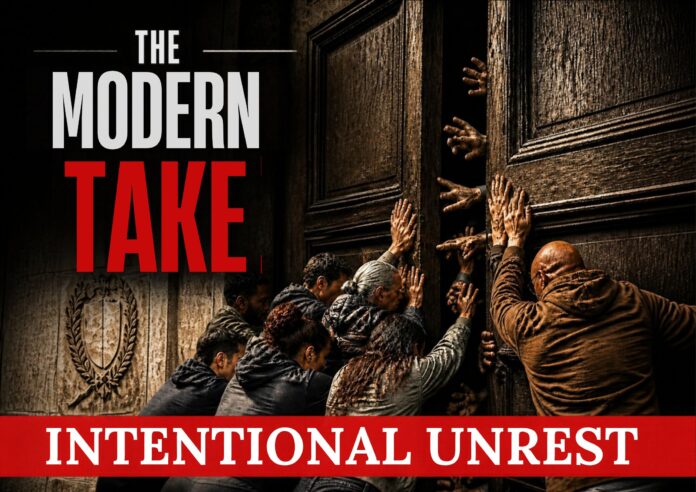
Intentional Unrest’s The Modern Take arrives with a clear purpose: to question political power, public trust, and the divisions that make it harder to think together. With a folk feel and a tracklist that takes on politicians, government, Australia’s fortunes, and America’s divisions, the album is less interested in easy answers than in making listeners reconsider the questions.
That intent is evident from the opening titles. “Trust Us” turns a familiar political reassurance into a challenge: what should politicians do to earn the public’s trust? The title track, “The Modern Take,” follows with a more unsettling possibility—that government keeps taking, but perhaps citizens have allowed it to happen. Together, they establish the album’s central tension. It’s not only a critique of those in power; it also asks listeners to reflect on their own role in the relationship.
That willingness to turn the lens back on the audience gives the album more to work with than a simple catalogue of political grievances. “The Modern Take” suggests that responsibility, influence, and consent are part of the conversation. Whether or not listeners agree with its perspective, the question is designed to linger: when did we give something away, and what might it take to claim it back?
“What If They Leave,” described as a reflective anthem for “Tax the Rich,” brings that questioning approach to an argument about wealth and fairness. The song’s framing appears to reach beyond the familiar slogan to consider the concerns and assumptions behind the debate. It’s a useful fit for an album that aims to encourage thought rather than merely reinforce talking points.
Open Mouth, Closed Doors establishes the understanding of when politicians lie. When they open their mouth, closed door deals and thing left for everyone is simply the hook of Tax, Tax, Tax.
The album’s standout, “Divided States of America,” broadens the focus from individual politicians or policies to the division itself. Crucially, the song doesn’t take sides. Instead, it asks why people have allowed the country to become so fractured. That choice gives the track a distinct role: rather than add another voice to the political shouting match, it challenges listeners to step back and consider how the conflict is sustained—and who gains from keeping people apart.
That theme makes the album’s title feel especially apt. A “modern take” might suggest a fresh perspective, but Intentional Unrest’s approach is also a call to re-examine familiar positions. “Double Down” targets the impulse to cling to a side even when facts challenge its talking points. It’s a pointed subject in a climate where changing one’s mind can be treated as weakness. The song’s premise pushes in the opposite direction, asking whether conviction is still useful when it refuses to listen.
Other tracks focus on the habits and structures of political life. “I Don’t Recall” takes aim at selective memory in hearings and official procedures—a subject with an instantly recognisable edge. The title evokes a familiar kind of evasion, where forgetting can seem less like a lapse than a way to avoid accountability. “On the Nose,” meanwhile, tells a tale of politicians breaking election promises. Taken together, these songs place responsibility and credibility at the heart of the album: what does it mean to represent people when trust can be earned, squandered, or dodged?
“Big Government” shifts the focus toward the relationship between government, voters, business, and innovation. Its argument, as described by the artist, is that an expanding government can create voters who depend on it, while innovation and business fail to grow. This is one of the album’s more openly ideological premises, and listeners may bring strong views of their own to it. But that also makes it an important part of the record’s wider challenge: can people examine an argument without immediately reducing it to a partisan label?
The album also looks beyond American politics. “Lucky Country” turns to Australia, reflecting on the country’s abundance and the perceived squandering of its potential by politicians. It gives The Modern Take a broader sense of place and stakes: political choices matter not only in national debates but in how a country cares for what it has.
As a whole, the tracklist moves among trust, power, division, accountability, and national potential. Its strongest thread is the insistence that listeners look past familiar scripts. The album questions politicians, but it also challenges audiences not to become automatic participants in the very divisions they criticise. That distinction matters. A record that only blames one side risks becoming another piece of partisan noise; The Modern Take aims instead to make reflection part of the response.
The folk feel is a natural match for this kind of material. Folk songwriting often makes room for direct language and shared concerns, and the style can give political themes a human scale. Based on the album’s described aims and subjects, Intentional Unrest uses that sensibility to invite conversation rather than present politics as distant spectacle.
Not every listener will agree with every premise—“Big Government” and the album’s broader critiques are likely to prompt debate. But debate may be part of the point. The Modern Take is at its most compelling when it asks questions that resist easy dismissal: How is trust earned? Why do people double down when confronted with inconvenient facts? Why has division become so difficult to escape? And what happens when promises, resources, or public confidence are squandered?
Intentional Unrest’s album doesn’t offer a tidy resolution. Instead, it asks listeners to pause, look beyond the talking points, and think constructively about how things got this way. In a world where political arguments often reward certainty over curiosity, that invitation is the record’s most valuable contribution.

